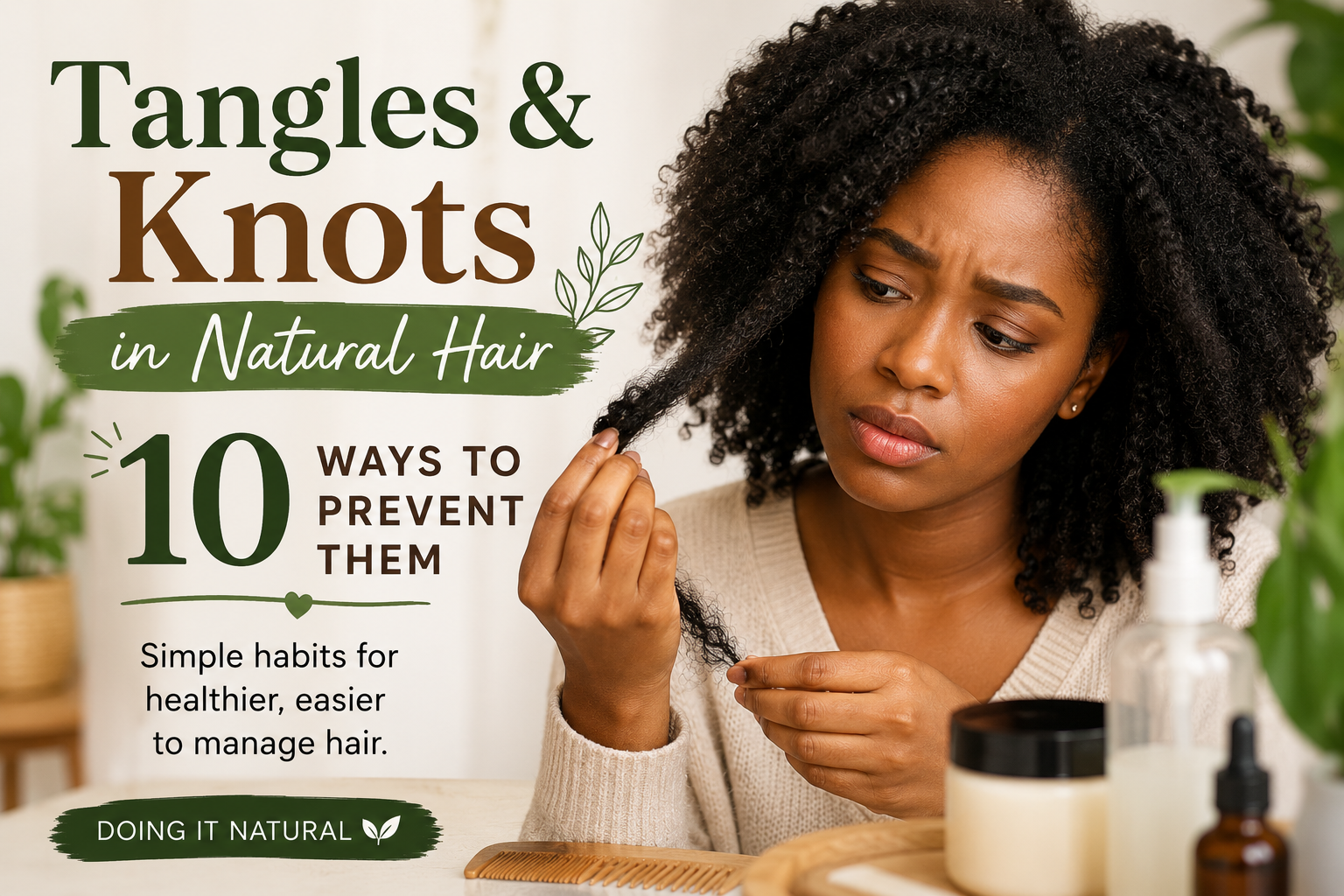
Tangles and Knots in natural hair are common, especially if you have 4B or 4C hair, you probably know the frustration of dealing with tangles and knots.
Sometimes it feels like you detangle your hair today only to find another knot tomorrow!
The good news is that you don’t have to completely eliminate tangles to have healthy natural hair. The goal is to reduce unnecessary tangling and handle your hair gently when it does happen.
I’ve learned over the years that consistent hair care makes a huge difference. When I neglect my hair for too long, it becomes much harder to manage. But when I keep it moisturised, stretched and properly maintained, my hair becomes much easier to work with.
Here are 10 things that can help prevent excessive tangling and knotting in natural hair.

1. Keep Your Hair Stretched
One of the biggest things that can help reduce tangling in type 4 hair is keeping it stretched.
When tightly coiled hair shrinks, the strands can wrap around one another more easily. Stretching your hair doesn’t mean you have to use heat. You can use methods such as:
- Two-strand twists
- Braids
- Bantu knots
- African threading
- Twist-outs
- Braid-outs
The aim isn’t to eliminate your natural shrinkage. It’s simply to keep your strands more organised and reduce how much they intertwine.
2. Don’t Ignore Your Ends
Your ends are the oldest part of your hair, so they need plenty of attention.
When ends become excessively dry, split or damaged, they can catch on neighbouring strands and contribute to tangling.
You don’t need to follow a strict rule that says you must trim every three months. Instead, pay attention to the condition of your ends and trim when necessary.
If you’re constantly finding split ends, single-strand knots or ends that won’t stay moisturised, it may be time for a trim.
3. Protect Your Hair
Protective or low-manipulation styles can help reduce the amount of daily friction and handling your hair experiences.
Braids, twists, tucked-away styles and other gentle styles can keep your ends from constantly rubbing against clothing and other surfaces.
However, protective doesn’t mean tight.
A hairstyle that causes pain, pulling or constant tension can damage your hair and scalp. Dermatologists warn that repeated tight hairstyles can contribute to traction alopecia.
Your protective style should actually feel protective!
4. Don’t Skip Detangling
This is one of the biggest lessons I’ve learned about natural hair.
Leaving tangles in your hair doesn’t usually make them disappear. They can become bigger and more difficult to remove later.
Detangle gently and patiently, preferably in manageable sections.
For tightly coiled hair, dermatologists recommend thoroughly wetting the hair and using conditioner before detangling with your fingers or a wide-tooth comb. Working in sections can make the process easier.
And remember:
Ends → middle → roots.
Don’t start by forcing a comb from your roots through a mass of tangled hair.

I recently wrote more about this here:
[Are You Combing Your Natural Hair the Right Way?]
5. Braid or Twist Your Hair Before Bed
If you’ve worn your hair loose all day, don’t simply go to bed with it completely loose and tangled.
Before sleeping, gently put your hair into a few loose twists or braids.
This helps keep the strands organised and can reduce friction while you sleep. A loose pineapple, braid or twists can also help preserve your hairstyle.
If you use a satin or silk bonnet or pillowcase, that can further reduce friction.

6. Stop Constantly Touching Your Hair
I called this “hand-in-hair syndrome” in my original article, and honestly, I still think it’s a real thing! 😂
Sometimes we don’t even realise how often we’re touching, separating, fluffing and rearranging our hair.
Constant manipulation can contribute to dryness, tangling and breakage.
So once you’ve styled your hair, leave it alone as much as possible.
And yes, that includes constantly asking other people to touch your hair because they love your curls. 😂
7. Keep Your Hair Moisturised
Dry hair tends to be harder to manage.
A good conditioning and moisturising routine can make your hair softer and easier to detangle. The American Academy of Dermatology also recommends conditioning curly/coily hair and notes that conditioner can make hair easier to manage and detangle.
You can experiment with the LOC or LCO method to find what works best for your hair.
For example:
L — Liquid/Leave-in
O — Oil
C — Cream
Or:
L — Liquid/Leave-in
C — Cream
O — Oil
There isn’t one method that works for everybody. Pay attention to how your hair responds.

8. Pay Attention to Your Ends
Your ends are particularly vulnerable to dryness and friction, so don’t forget about them when moisturising.
Apply your leave-in or moisturiser throughout your hair, paying particular attention to dry areas and the ends.
You can also use a small amount of oil if that works well for your hair.
The goal isn’t to drown your hair in oil — it’s to keep your routine balanced and prevent your hair from becoming unnecessarily dry and difficult to manage.
9. Don’t Keep the Same Style in for Too Long
I know the feeling.
You finally get your braids or twists done and think:
“I’m keeping these in FOREVER.” 😂
But leaving a style in for too long can eventually lead to accumulated shed hair, buildup and tangling when you finally take it down.
The longer you leave a style in, the more important it becomes to pay attention to your scalp, new growth and the condition of your natural hair.
And remember: if a style becomes painful, excessively tight or uncomfortable, don’t wait until the planned removal date.
10. Wash Your Hair in Sections
Washing loose, highly textured hair can sometimes leave you with a bigger tangling problem than you started with.
Try dividing your hair into several manageable sections before washing.
You can gently braid or twist each section and work through them one at a time.
The American Academy of Dermatology specifically recommends washing long or thick curly hair in sections to reduce damage or tangling.
You don’t have to use exactly six sections like I suggested in my original article. Use whatever number makes your hair manageable.
What If Your Hair Is Already Tangled? How do you get rid of the tangles and Knots?
Don’t panic — and don’t attack the knot with a comb!
Start by:
- Adding water or a suitable conditioner/leave-in for slip.
- Separating your hair into manageable sections.
- Using your fingers to gently loosen the biggest tangles.
- Starting at the ends.
- Working gradually towards the roots.
- Using a wide-tooth comb only when the section is sufficiently detangled.
- Taking your time.

If a knot won’t move, stop pulling. Add more slip and work around the knot with your fingers.
For tightly coiled hair, gentle detangling while the hair is thoroughly wet and conditioned is supported by dermatologists’ guidance.
Final Thoughts on Tangles and Knots
Tangles are part of having natural hair. You don’t need to achieve completely tangle-free hair to have healthy hair.
The key is learning how to reduce unnecessary tangling and, when knots do happen, removing them gently.
For me, one of the biggest lessons has been that consistency matters.
When I neglect my hair, it becomes harder to manage. When I give it regular attention, keep it moisturised, detangle it properly and protect it, my hair responds so much better.
And that’s something I’m rediscovering as I get back into caring for my natural hair.
Natural hair doesn’t have to be perfect. It just needs care. 🌿

Leave a Reply